Know the facts and discuss risky behaviors with your student. You can make a difference!
Posted by Pamela Williams
Photo credit – Erik Mclean ~ Pexels
Key findings from the 2021 Missouri Assessment of College Health Behaviors concerning alcohol, cannabis, drugs, tobacco, interpersonal violence, and mental health. Talking to your student can make a difference!
Alcohol Use
Most Missouri college students (71%) report using alcohol in the past year. Binge-drinking (defined as a pattern of drinking that brings a person’s blood alcohol concentration (BAC) to 0.08 g/dl or above, which typically means consuming 4+ drinks for women and 5+ drinks for men in a two-hour period at least once in the past two weeks) is a high-risk alcohol use behavior that PIP closely monitors each year. The binge-drinking rate declined to 21% in 2021 from 22% in 2020 and is below the national average of around 38%. Of students who binge-drink, approximately 5.3% are frequent binge drinkers, defined as binge-drinking 3 or more times in the past two weeks.
Underage Alcohol Use
Most Missouri college students (67%) report that they first started drinking before age 21. Fifty-nine percent (59%) of underage Missouri college students report consuming alcohol in the past year and 18% of underage students report binge-drinking in the past two weeks (both decreases from 2020, 64% and 19%, respectively). Underage students report that they obtain alcohol in a variety of ways, the most common being from over 21 friends (30%), from parents (11%), or alcohol being readily available at home (8.4%)* (alcohol being readily available at home was a new option added in 2021 to account for changes due to COVID-19).
Consequences of Alcohol Use
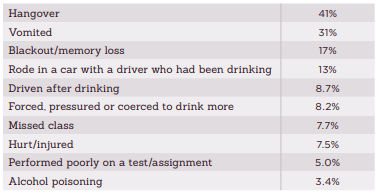
The MACHB tracks consequences and related behaviors of alcohol use experienced at least once in the past year, shown in the table below. While rates of impaired driving continue to decline, 13% of students report riding in a car with a drinking driver and 8.7% report driving after consuming alcohol. Students also report experiencing academic consequences of alcohol use such as missing class (7.7%) or performing poorly on a test or assignment (5.0%).
Cannabis
Cannabis is the most used drug by Missouri college students after alcohol. The percentage of students who report using cannabis in the past year remained steady from 29% in 2020 to 28% in 2021. Approximately 10% of students statewide report using cannabis at least once per week. Of students who report using cannabis, 32% report driving after use at least once in the past year. Twenty-six percent (26%) of Missouri college students report using both alcohol and cannabis (though not necessarily at the same time) in the past year. MACHB data also shows that students who use alcohol at higher risk levels, including binge drinking and frequent binge drinking were more likely to have used cannabis than students who do not binge drink. Only 19% of students who do not binge drink had used cannabis in the past year compared to 55% of students who binge drink and 64% of students who frequently binge drink. Related to perceptions of others’ use, though 70% of students have not used cannabis in the past year, only 9% of students believe that their peers have not used. Among students who use cannabis, about one-fifth (21%) are currently trying to use less or quit using cannabis altogether. Related to changes in Missouri laws around cannabis, 9 out of 10 students who have used cannabis in the past year do not have a medical card or prescription. Additionally, 17% of Missouri college students have used a CBD (cannabidiol) product in the past year, and while CBD is legal to purchase, it is not well regulated and can contain THC (tetrahydrocannabinol, the psychoactive component in cannabis).
Illegal and Prescription Drugs
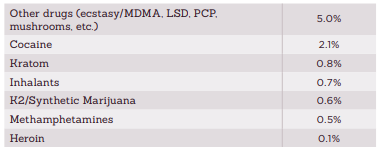
Approximately 7.4% of students report using at least one illegal drug (not including cannabis) in the past year and use rates of various types are shown in the table below:
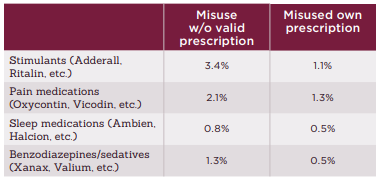
Approximately 6.4% of Missouri college students report prescription drug use without a doctor’s prescription in the past year. Additionally, 3.1% of students with a valid prescription report using in a manner other than prescribed in the past year. Of students who report misuse of either type, 29% have combined them with alcohol at least once, which can have serious health effects. Rates of misuse both with and without a prescription are shown in the table below:
Tobacco and Nicotine
In 2021, a new question about age of first use for tobacco/nicotine products was added, with the highest percentage of students (8.2%) reporting that they first used at age 18. Twenty-four percent (24%) of Missouri college students report using any tobacco or nicotine products in the past year. Usage rates for various types are as follows: e-cigarettes/vaporizers (15%), JUULs (13%), cigarettes (9.8%), cigars (4.4%), smokeless tobacco (3.1%), and hookah (2.3%).*.
Interpersonal Violence
Approximately 25% of Missouri college students have experienced non-consensual sexual contact (NCSC) in their lifetime, and 5.7% have experienced it in the past year. Of all NCSC, 6.9% occurred while the student was attending their current college or university. The majority of NCSC occurred off-campus and not related to university events (57%) or on-campus in residence halls (29%)*. In the past year, 15% of students have experienced abuse in a relationship (e.g., verbal, physical, psychological, etc.).
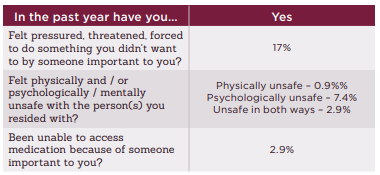
In 2021, new questions were added about experiences of safety in the past year, which are potentially related to interpersonal violence. These questions (shown in the table below) ask about feelings of coercion, physical and mental safety in the home, and the ability to access medication.
Well-Being
In 2021, questions about stress levels were included in the survey, with 37% of students reporting that their stress is overwhelming or unbearable (an increase from 24% in 2020). The most common source of stress is school/academics (91%). Questions related to food insecurity in the past 30 days are also asked with 7.6% of students who very often/always worried whether their food would run out before they got money to buy more, 5.2% of students who said the food they bought didn’t last and they didn’t have money to get more, and 11% of students who said they couldn’t afford to eat balanced meals.
Finally, questions on flourishing related to feelings of purpose, being engaged, and having positive self-esteem were reported highly among students, with the average score on the flourishing scale being 45.29 (on a scale ranging from 7 to 56).
Mental Health
Missouri college students self-report experiencing issues related to mental health, the most common being anxiety (64%), major depression (35%), panic attacks (30%), and chronic sleep issues (25%).* In 2021, new questions were added to the survey to ask students if they had received a diagnosis from a mental health or medical professional for a mental health concern. Forty-three percent (43%) of students have been diagnosed with at least one type of mental health issue in the past year; 36% were diagnosed with an anxiety disorder, 24% were diagnosed with major depression, and 6.6.% were diagnosed with chronic sleep issues. For students who had experienced a mental health concern in the past year, 33% did not seek assistance. Among the 69% who did seek assistance, their primary source of assistance was friends/family (36%), an off-campus mental health provider (18%), an off-campus medical doctor (16%), or the university counseling center (12%)**
Suicidality
In the past year, 25% of students have had suicidal thoughts and 1.6% attempted suicide. For those who had thoughts or attempts, 38% sought assistance. The most common places students primarily sought assistance were an off-campus mental health provider (35%) or the university counseling center (22%). Additionally, 44% of Missouri college students have been concerned about a friend having suicidal thoughts or exhibiting behaviors in the past year.
Summary
Partners in Prevention continues to monitor critical health behaviors of college students including high-risk drinking, cannabis and other drug use, mental health, interpersonal violence, and tobacco use. Data consistently shows that student success and academic achievement is impacted by substance misuse, and prevention efforts are vital to the mission of institutions of higher education. For more information about Partners in Prevention and to explore our research, visit mopip.org.
Partners in Prevention (PIP) is Missouri’s higher education substance misuse consortium dedicated to creating healthy and safe college campuses. The coalition is comprised of 24 public and private colleges and universities in the state. The campuses in the coalition work to prevent high-risk behaviors by implementing evidence-based strategies. These strategies include education, social norming campaigns, policy review and enforcement, and more. To measure progress and obtain data needed for the implementation of programs, PIP created the Missouri Assessment of College Health Behaviors (MACHB) Survey. The MACHB is an annual, online survey that has been implemented each spring since 2007. The survey assesses the roles that alcohol, drugs (illegal and prescription), tobacco/nicotine, interpersonal violence, and mental health have on student health and wellness.
Source
Please Note: Missouri S&T does not endorse or have a relationship with SOURCE and articles are provided for information purposes only. Missouri S&T and SOURCE do not assume responsibility for error or omission in materials.
Parent & Family Relations
Norwood 107• 320 W. 12 Street / parents@mst.edu
Phone: 573-341-4209 • Website: http://parents.mst.edu/
